'%20transform='translate(-405.000000,%20-411.000000)'%20fill='%23fff'%20fill-rule='nonzero'%3e%3cg%20id='Banner-Dark'%20transform='translate(0.000000,%20117.000000)'%3e%3cg%20id='refresh'%20transform='translate(405.000000,%20294.000000)'%3e%3cpath%20d='M7.02355586%2011.4122757C7.35186534%2011.0356596%207.08442404%2010.4476213%206.58477849%2010.4476213H5.08884368C5.07909923%2010.2996072%205.07364973%2010.1504386%205.07364973%2010.0000231%205.07364973%206.27284%208.10588262%203.24060711%2011.8330195%203.24060711%2013.6241512%203.24060711%2015.2545224%203.94109918%2016.465282%205.08221592L18.5747015%202.61446843C16.7281512.925260987%2014.3517984.0%2011.8330195.0%209.16193168.0%206.65072672%201.04020856%204.76196586%202.92892324%202.87325118%204.8176841%201.83304262%207.32888906%201.83304262%209.99997691%201.83304262%2010.1497459%201.83678338%2010.2989145%201.84329507%2010.4475751H.583259096C.083613545%2010.4475751-.183873934%2011.0356134.144481725%2011.4122295L2.98695183%2014.672695%203.5839957%2015.3575313%205.72759011%2012.898697%207.02355586%2011.4122757z'%20id='Path'/%3e%3cpath%20d='M23.5216035%209.50998344%2021.4015159%207.07811955%2020.0820895%205.56468168%2018.1982702%207.72550206%2016.6425756%209.50998344C16.3142661%209.88659953%2016.5817074%2010.4746379%2017.0813529%2010.4746379H18.5755328C18.3310903%2013.9811623%2015.4005968%2016.7593929%2011.8330657%2016.7593929%2010.2757547%2016.7593929%208.83994917%2016.2297289%207.69578441%2015.3414599L5.5862263%2017.8093921C7.35348172%2019.2286182%209.53383718%2020%2011.8331119%2020%2014.5041997%2020%2017.0154047%2018.9598376%2018.9041656%2017.0710768%2020.6806112%2015.2946311%2021.7061338%2012.9675085%2021.8218203%2010.4746841H23.0828723C23.5824717%2010.4746379%2023.849913%209.88659953%2023.5216035%209.50998344z'%20id='Path'/%3e%3c/g%3e%3c/g%3e%3c/g%3e%3c/g%3e%3c/svg%3e)
Winning prospects over isn't easy. You must overcome objections, discuss your offerings and convey your business’s value to resonate with their needs. Thankfully, this is where an effective business proposal comes in. The best proposals communicate your business’s unique proposition and highlight what makes you different from your competitors to win your prospects over.
This article discusses the rules for developing a powerful proposal that can be a reliable motor for your business.
Let’s get started.
What is a business proposal?
A business proposal is a formal proposal created by businesses for potential customers. It is crafted to persuade customers to purchase your product or patronize your service. Two types of business proposals exist: unsolicited business proposals and solicited business proposals.
Unsolicited business proposals are sent to prospects without their request. This proposal will sensitize potential customers about your business and its offerings. Conversely, solicited business proposals are sent as per your potential client’s request. This prospect category has shown interest in your business but is undecided. So, the proposal gives them deeper insights into your offerings and helps them decide if you are the best fit for them.
The ultimate rules for creating effective proposals
Follow these rules to create a business proposal that attracts and converts prospects to customers.
Create a fascinating title page
A title page is among the most vital elements of your business proposal; it’s how you create the first impression. As a tone-setter, your title page must captivate your prospects and propel them to read the rest of your proposal.
It contains essential details about your business, the proposal’s focus, and its benefits. So, include your name, the company’s name, the date you submitted the proposal, and what the proposal is about. For example, is it a digital marketing or event photography proposal? Keep your title page informative but concise to avoid overwhelming your reader.
Create a fascinating design, and keep the details intriguing to excite prospects to turn to the next page. Do this by conveying benefits. What will they discover? How will it help them? Highlight these key benefits in your title page to engage prospects from the get-go.
Explain your “why”
Your prospects want to know why you are the best choice for them. So, include your “why” in your executive summary. This is where you highlight your unique value proposition to distinguish your offerings from your competitors. What are the special benefits of subscribing to your services or purchasing your product?
It’s not entirely about how exceptional your product is. It is how effectively it meets your consumers’ needs. Therefore, focus on your prospects when explaining your “why.” What are their challenges and conditions, and how do your product and services uniquely meet these needs? After reading your business proposal, your prospect should be able to identify what makes you different from similar businesses and why they should choose you.
Highlight your qualifications
The way to win customers over is to earn their trust. Show them you can deliver excellent services based on your qualifications, experiences, and customer reviews. This section focuses on why prospects must trust your products or service. To do this, add certification, testimonials, and other forms of social proof to attest your competence.
Include a pricing section
Every winning proposal has a pricing section that tells prospects how much your products or project costs. Prospects don’t want to be left guessing. They want to know if your pricing options are within their budget. They also want to choose the package that works best for them. So, include a pricing section in your proposal to facilitate their decision-making process.
However, avoid overwhelming your readers while you are at it. Do this by limiting the pricing section to a few options. Multiple options get prospects confused, and confused people don’t buy. So, streamline your pricing options to help your prospects decide faster.
Include terms and conditions
The terms and conditions section sets the tone of your relationship with your prospect if they decide to do business with you. It highlights project timelines, payment structure, and schedules. It also outlines your expectations and what you require from the client. Other additional details on your work policies also fit into this section.
Keep your terms and conditions clear and easy to understand. Finally, check in with your legal team before sending your proposal to your prospect.
Key elements of winning proposals
Excellent business proposals are characterized by five vital features that help you convey your business’s values effectively. Here are key elements to include in your business’s proposal.
- Page title: A title page contains basic information about your business and what the business proposal aims to achieve. It includes the date, business name, and business proposal benefits.
- Table of content: A table of contents outlines the sections the business proposal covers. Prospects can jump into different proposal sections with the table of contents.
- Executive summary: The executive summary is an overview of your business proposal. It briefly discusses every aspect of your proposal, what your business does and how it satisfies customers’ needs.
- The problem statement: This section identifies users' challenges and needs. It shows you understand their situations clearly, placing you in the best position to help them.
- The proposed solution: This part introduces your product or service as the hero in your prospect’s story. It shows how your business helps solve your customers' problems and help them achieve their goals.
- Qualifications: This consists of your experience, qualifications, certifications, and reviews for trust and credibility.
- Terms and conditions: This summarizes what you and your prospect agree to if they decide to buy from you.
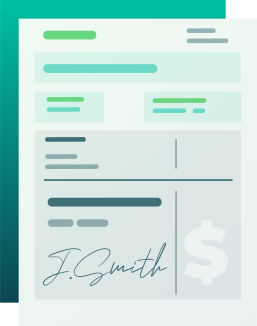
- Signature box: The signature box is where the client signs after agreeing to your terms and conditions.
Final Thoughts
Effective business proposals are vital to growing your client base and thriving. Therefore, to develop a working business proposal, create an engaging title page, and highlight your USP and qualifications. Finally, offer pricing options and outline terms and conditions.
FAQs
What are the best business proposals?
The best business proposals address the prospects’ problems, project the business as a solution, provide pricing options, and highlight terms and conditions.
What are 5 things all proposals should include?
The key elements of all business proposals include a title page, table of content, executive summary, qualifications, terms and conditions, proposed problem, and solution.
What are the 4 qualities of a good proposal?
A good proposal is informative, clear, and engaging. Finally, it includes the title page, pricing, terms and conditions, and qualifications.